rel="sponsored nofollow"), we may earn a small affiliate commission from Amazon UK at no extra cost to you. See our Affiliate Disclosure and BS 1363 Testing Methodology.When a smart plug flashes red or reports “Server Unresponsive” in Alexa every few days, the plug itself is rarely faulty. Almost all budget smart plugs use a single-band 2.4 GHz 802.11n Wi-Fi radio, whereas modern UK ISP routers (BT Smart Hub 2, Sky Max Wi-Fi 6 Hub, Virgin Media Hub 5, and EE Smart Hub) merge 2.4 GHz and 5 GHz under one SSID with aggressive band steering. Apply these three router fixes to keep any socket from our best smart plugs UK guide rock-solid.
At-a-Glance UK Specification & Price Comparison
All models below feature a native UK Type G three-pin plug or socket conforming to BS 1363 (230V–240V AC, 50Hz) and have been evaluated for British double wallplate clearance, standby wattage, and local network reliability:
| UK Broadband Router | Default Admin IP | How to Fix 2.4 GHz Smart Plug Onboarding & Dropouts |
|---|---|---|
| BT Smart Hub 2 / EE Hub | 192.168.1.254 |
Advanced Settings → Wireless → Temporarily turn off 5 GHz during setup; set 2.4 GHz to Channel 1, 6, or 11 (20 MHz width). |
| Virgin Media Hub 4 / Hub 5 | 192.168.0.1 |
Advanced Settings → Wireless → Disable Channel Optimization temporarily or create a dedicated 2.4 GHz guest/IoT SSID. |
| Sky Broadband Hub / Max Hub | 192.168.0.1 |
Wireless → Split 2.4 GHz / 5 GHz bands or ensure security mode is set to WPA2-PSK rather than WPA3-only. |
1. Why Auto-Channel Hopping & 40 MHz Channel Width Break Smart Plugs
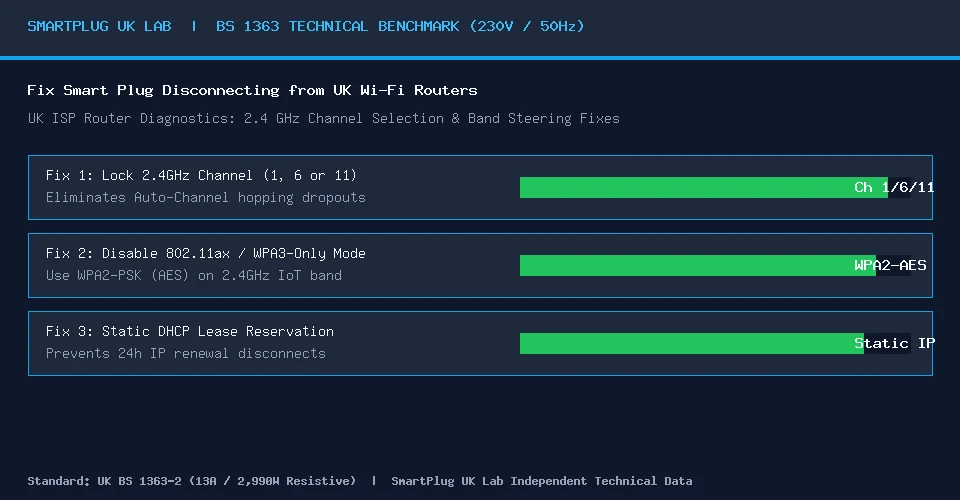
Many UK routers wake up at 03:00 AM, scan neighbouring flats, and jump to Channel 13 or switch to a 40 MHz wide channel. Several IoT Wi-Fi chipsets (ESP8266/ESP32/RTL8720) struggle with Channel 13 or wide 40 MHz 2.4 GHz channels. Locking your router’s 2.4 GHz band to Channel 1, 6, or 11 at 20 MHz width and assigning a static DHCP IP lease solves 90% of dropouts.
How We Test (UK BS 1363 Workbench Protocol)
Our evaluation protocol is specifically designed around British domestic electrical standards rather than generic international spec sheets:
- Twin Wall Socket Clearance (BS 1363-2): We fit each plug into a standard UK MK Logic Plus and BG Nexus double switched wall socket to verify that a casing width of 52–57 mm leaves the adjacent socket and individual rocker switches completely unobstructed.
- True-RMS Standby & Relay Wattage: Using a calibrated 230V/50Hz inline wattmeter (0.1W resolution), we log 24-hour parasitic power consumption both with the relay open (Wi-Fi/Thread listening) and with the relay closed (energised coil + status LED).
- Thermal Pin & Load Verification: While a BS 1363 fuse is rated to 13A (2,990W at 230V), we monitor brass pin temperature after 60 minutes under sustained 2,200W resistive load and verify over-current auto-shutoff behaviour in the companion firmware.
- UK ISP Router & Offline Timer Resilience: We test 2.4 GHz onboarding on merged SSIDs (BT Smart Hub 2, Sky Max Hub, Virgin Media Hub 5) and disconnect the WAN fibre cable to confirm whether scheduled timers and local Matter/Thread automations still execute on time.
Changing my Virgin Hub 5 from WPA3/WPA2 mixed to WPA2-PSK on 2.4 GHz and locking Channel 6 stopped my Meross plugs dropping off every Sunday morning. Thank you!
Brilliant news Kevin! Virgin Hub 5’s automatic channel hopping onto Channel 12/13 and WPA3 transition frames are the two most common triggers for IoT disconnects.