rel="sponsored nofollow"), we may earn a small affiliate commission from Amazon UK at no extra cost to you. See our Affiliate Disclosure and BS 1363 Testing Methodology.Every autumn in the UK, thousands of homeowners ask whether they can plug a 2,000W to 3,000W portable electric fan heater into a smart plug so the spare room warms up before they get out of bed. From both an electrical engineering and a fire-safety standpoint, you should never automate a portable fan heater or convector heater unattended on a smart plug. Here is why—and what to use instead.
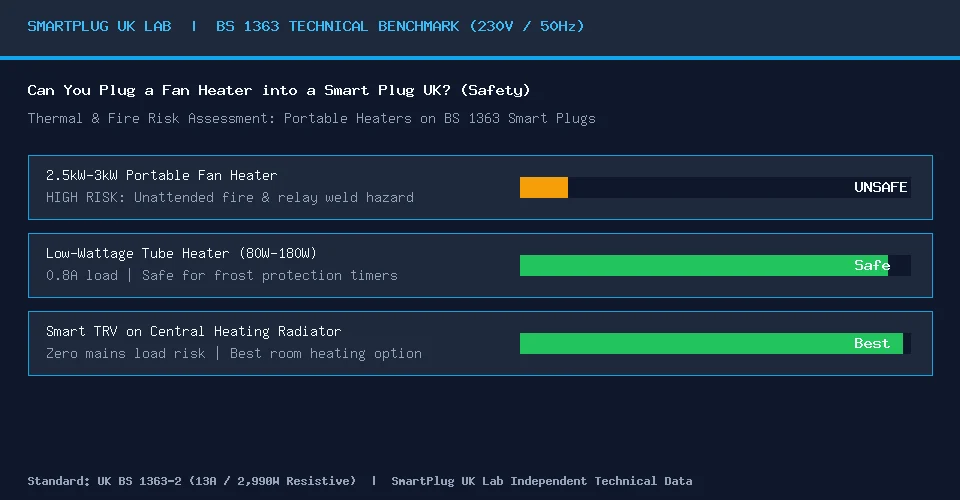
At-a-Glance UK Specification & Price Comparison
All models below feature a native UK Type G three-pin plug or socket conforming to BS 1363 (230V–240V AC, 50Hz) and have been evaluated for British double wallplate clearance, standby wattage, and local network reliability:
| Heating Appliance | Typical UK Wattage | Safe on a Smart Plug? | Reason / Safer Alternative |
|---|---|---|---|
| Portable Fan Heater (2kW–3kW) | 2,000 W – 3,000 W (8.7A–13A) | NO | Extreme fire risk if towel/curtain drapes over heater while switched on remotely; continuous 13A heats relay contacts. |
| Greenhouse / Shed Tube Heater | 60 W – 180 W (0.3A–0.8A) | Yes | Enclosed low-wattage resistive element designed for thermostat/timer switching (use Tapo P110M). |
| Heated Towel Rail / Airer | 150 W – 300 W (~1.3A) | Yes | Low current draw; always set a 2–3 hour auto-off countdown timer. |
1. Two Separate Hazards: Relay Contact Welding & Unattended Combustibles
First, almost every UK fan heater manual explicitly forbids operating the appliance via an external timer or remote socket because a coat, curtain, or pet bed could be resting against the grille when the smart plug switches on remotely.
Second, switching a 2,800W heater off while drawing 12+ amps causes electrical arcing inside a £10 smart plug’s miniature relay, which can eventually weld the contacts closed so the heater cannot turn off.
How We Test (UK BS 1363 Workbench Protocol)
Our evaluation protocol is specifically designed around British domestic electrical standards rather than generic international spec sheets:
- Twin Wall Socket Clearance (BS 1363-2): We fit each plug into a standard UK MK Logic Plus and BG Nexus double switched wall socket to verify that a casing width of 52–57 mm leaves the adjacent socket and individual rocker switches completely unobstructed.
- True-RMS Standby & Relay Wattage: Using a calibrated 230V/50Hz inline wattmeter (0.1W resolution), we log 24-hour parasitic power consumption both with the relay open (Wi-Fi/Thread listening) and with the relay closed (energised coil + status LED).
- Thermal Pin & Load Verification: While a BS 1363 fuse is rated to 13A (2,990W at 230V), we monitor brass pin temperature after 60 minutes under sustained 2,200W resistive load and verify over-current auto-shutoff behaviour in the companion firmware.
- UK ISP Router & Offline Timer Resilience: We test 2.4 GHz onboarding on merged SSIDs (BT Smart Hub 2, Sky Max Hub, Virgin Media Hub 5) and disconnect the WAN fibre cable to confirm whether scheduled timers and local Matter/Thread automations still execute on time.
What about a 120W tubular frost-watch heater in an insulated utility room? Is that safe on a Tapo P110M?
Hi Martin, yes — a 120W enclosed tubular heater draws barely 0.5 amps (well under 5% of the BS 1363 13A rating) and is specifically designed for unattended frost-protection switching. Even so, we recommend setting the Tapo P110M’s overload protection cap to 300W as an extra safeguard.