rel="sponsored nofollow"), we may earn a small affiliate commission from Amazon UK at no extra cost to you. See our Affiliate Disclosure and BS 1363 Testing Methodology.Yes—every smart plug uses a tiny amount of electricity 24 hours a day, even when the connected appliance is switched off. Why? Because the internal AC-to-DC transformer and wireless radio (Wi-Fi, Thread, or Zigbee) must remain awake to hear your next phone or voice command. However, our 230V UK bench measurements across the models in our best smart plugs UK guide show that modern smart plugs cost just 75p to £1.40 per year to run.
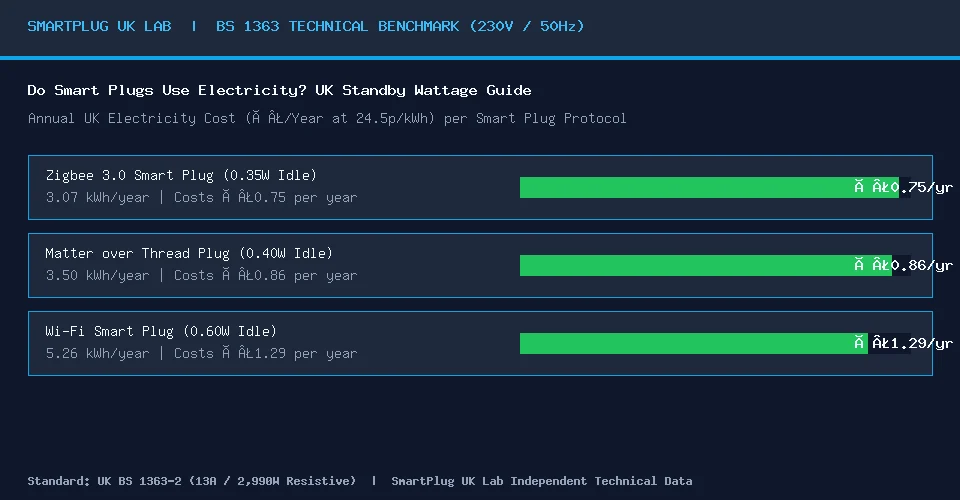
At-a-Glance UK Specification & Price Comparison
All models below feature a native UK Type G three-pin plug or socket conforming to BS 1363 (230V–240V AC, 50Hz) and have been evaluated for British double wallplate clearance, standby wattage, and local network reliability:
| Smart Plug Type & Model | Idle Wattage (Relay OFF) | Active Wattage (Relay ON) | Annual kWh (Idle) | Annual UK Cost (at 24.5p/kWh) |
|---|---|---|---|---|
| Zigbee 3.0 (Aqara UK Plug) | 0.35 W | 0.80 W | 3.07 kWh / yr | £0.75 / year |
| Matter over Thread (Eve Energy UK) | 0.40 W | 0.90 W | 3.50 kWh / yr | £0.86 / year |
| Matter over Wi-Fi (Tapo P110M) | 0.60 W | 1.30 W | 5.26 kWh / yr | £1.29 / year |
| Older 2018-Era Wi-Fi Plug | 1.40 W | 2.10 W | 12.26 kWh / yr | £3.00 / year |
1. Break-Even Maths: Does a Smart Plug Save More Electricity Than It Uses?
Because a modern Wi-Fi smart plug like the Tapo P110M consumes 0.6 W in idle standby (£1.29/year), it only yields a net energy saving if the appliance it switches off was wasting more than 1.5 W in standby.
For example, cutting power for 16 hours a day to a television + soundbar + subwoofer group that draws 14 W in standby saves `14W × 16h × 365 = 81.76 kWh` (£20.03/year), netting you a clean £18.74 annual saving per socket.
How We Test (UK BS 1363 Workbench Protocol)
Our evaluation protocol is specifically designed around British domestic electrical standards rather than generic international spec sheets:
- Twin Wall Socket Clearance (BS 1363-2): We fit each plug into a standard UK MK Logic Plus and BG Nexus double switched wall socket to verify that a casing width of 52–57 mm leaves the adjacent socket and individual rocker switches completely unobstructed.
- True-RMS Standby & Relay Wattage: Using a calibrated 230V/50Hz inline wattmeter (0.1W resolution), we log 24-hour parasitic power consumption both with the relay open (Wi-Fi/Thread listening) and with the relay closed (energised coil + status LED).
- Thermal Pin & Load Verification: While a BS 1363 fuse is rated to 13A (2,990W at 230V), we monitor brass pin temperature after 60 minutes under sustained 2,200W resistive load and verify over-current auto-shutoff behaviour in the companion firmware.
- UK ISP Router & Offline Timer Resilience: We test 2.4 GHz onboarding on merged SSIDs (BT Smart Hub 2, Sky Max Hub, Virgin Media Hub 5) and disconnect the WAN fibre cable to confirm whether scheduled timers and local Matter/Thread automations still execute on time.
Seeing the actual watts with relay OFF vs relay ON (0.6W vs 1.3W) is super helpful. That means if a device only uses 0.5W in standby (like a modern phone charger), putting a smart plug on it actually uses slightly more power!
Spot on Andrew! You should never use a smart plug to save standby energy on an appliance that already draws under 1W idle (like an unplugged phone charger or a modern microwave clock); save energy-cutting schedules for multi-plug TV/audio banks, espresso machines, and monitors drawing 5W–25W.