rel="sponsored nofollow"), we may earn a small affiliate commission from Amazon UK at no extra cost to you. See our Affiliate Disclosure and BS 1363 Testing Methodology.Behind a media unit, computer desk, or aquarium cabinet, plugging four separate smart plugs into a standard passive extension block looks messy and wastes space. A dedicated UK smart extension lead (such as the TP-Link Tapo P304M or Meross MSS425FUK) gives you four individually controllable BS 1363 outlets in a single surge-protected strip. However, understanding how the 13A BS 1363 plug fuse limits total load is essential for electrical safety.
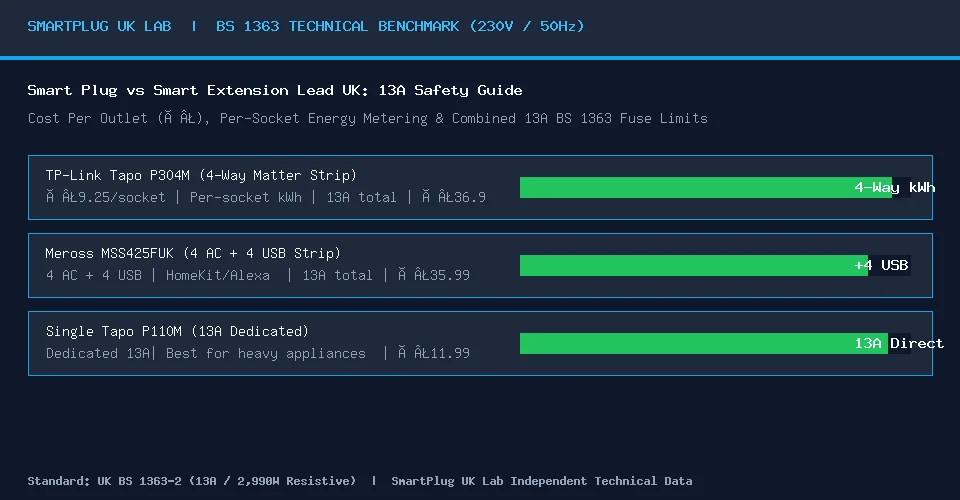
At-a-Glance UK Specification & Price Comparison
All models below feature a native UK Type G three-pin plug or socket conforming to BS 1363 (230V–240V AC, 50Hz) and have been evaluated for British double wallplate clearance, standby wattage, and local network reliability:
| Model | Controllable Outlets | Energy Monitoring | Max Load Rating | UK Price & Link |
|---|---|---|---|---|
| TP-Link Tapo P304M (UK) | 4 × BS 1363 AC Sockets | Yes (Independent per socket) | 13A / 2,990W Combined Total | £36.99 (Amazon UK) |
| Meross MSS425FUK (UK) | 4 × AC Sockets + 4 × USB-A (4A) | No (Switching + Timers + Surge) | 10A single socket / 13A Total | £35.99 (Amazon UK) |
| TP-Link Tapo P110M (Single) | 1 × BS 1363 AC Socket | Yes (Dedicated 13A channel) | 13A / 2,990W Dedicated | £11.99 (Amazon UK) |
1. The Golden Rule of UK Smart Extension Leads: Combined 13A (2,990W) Fuse Cap
Every British extension lead plugs into the wall via a single BS 1363 plug containing a 13-amp ceramic cartridge fuse (BS 1362). That means the sum of all four sockets running at the same time must never exceed 13A (2,990W at 230V). Smart extension leads are ideal for TVs, monitors, routers, lamps, and PCs (which together draw 150W–500W), whereas high-wattage kitchen or laundry appliances must always use a dedicated wall socket.
How We Test (UK BS 1363 Workbench Protocol)
Our evaluation protocol is specifically designed around British domestic electrical standards rather than generic international spec sheets:
- Twin Wall Socket Clearance (BS 1363-2): We fit each plug into a standard UK MK Logic Plus and BG Nexus double switched wall socket to verify that a casing width of 52–57 mm leaves the adjacent socket and individual rocker switches completely unobstructed.
- True-RMS Standby & Relay Wattage: Using a calibrated 230V/50Hz inline wattmeter (0.1W resolution), we log 24-hour parasitic power consumption both with the relay open (Wi-Fi/Thread listening) and with the relay closed (energised coil + status LED).
- Thermal Pin & Load Verification: While a BS 1363 fuse is rated to 13A (2,990W at 230V), we monitor brass pin temperature after 60 minutes under sustained 2,200W resistive load and verify over-current auto-shutoff behaviour in the companion firmware.
- UK ISP Router & Offline Timer Resilience: We test 2.4 GHz onboarding on merged SSIDs (BT Smart Hub 2, Sky Max Hub, Virgin Media Hub 5) and disconnect the WAN fibre cable to confirm whether scheduled timers and local Matter/Thread automations still execute on time.
On the Meross MSS425FUK, are the four USB-A ports switched individually or as one single USB bank?
Hi Neil, on the Meross MSS425FUK the four AC BS 1363 sockets switch individually (Outlets 1 to 4), while the four USB-A ports switch together as a single combined USB group.